
Imagine a traffic authority orders every car to drive at 1 km/h. Forever. No exceptions. Accidents would disappear overnight. So would everything else. Nobody would reach the hospital in time. Nobody would reach a job interview. A pizza would arrive, but only with fungus on it by then. The very slowness that prevents one problem creates a hundred new ones.
This is precisely the trade-off built into every GLP-1 injection — Ozempic, Wegovy, Rybelsus, Mounjaro. The mechanism that suppresses appetite is the same one that can eventually paralyze your gut. It’s a double-edged sword. Understanding the edge you’re not shown is the whole point here.
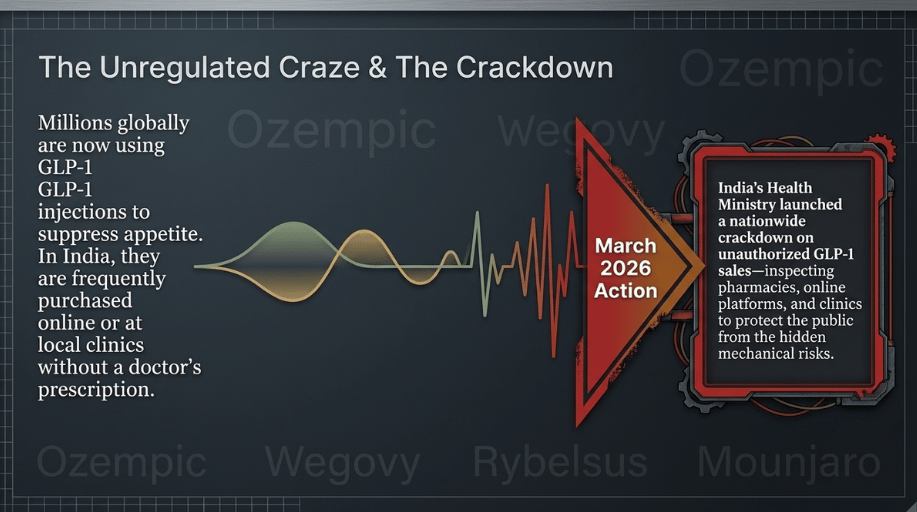
Share on WhatsAppMillions worldwide now take these injections. In India, they’ve become so popular that many buy them online, or from local clinics, without a doctor’s prescription at all. This is exactly why India’s health ministry launched a crackdown in March 2026 on unauthorized GLP-1 sales — inspecting pharmacies, online platforms, and clinics nationwide, to protect people from precisely the risks this article explains.
Part 1: How Weight-Loss Injections Work (The Natural Stomach Brake)
To understand these injections, first look at how your own body already works.
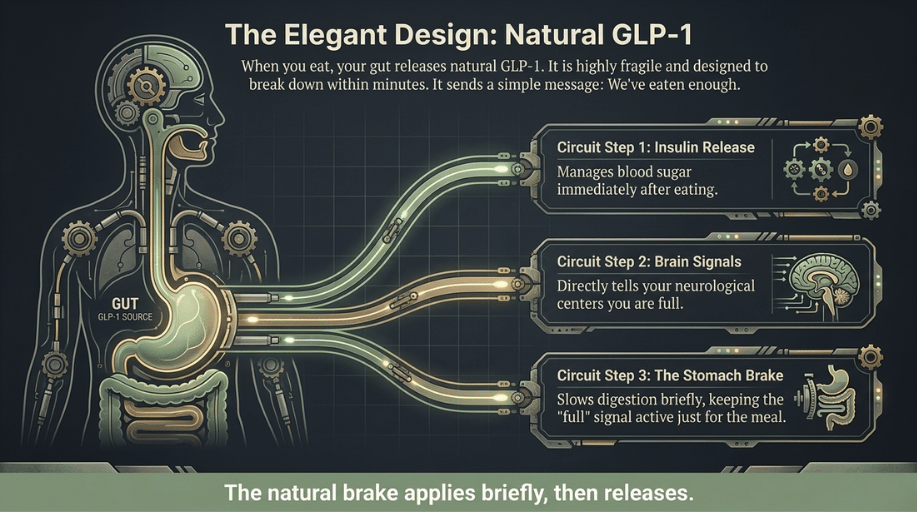
When you eat, your gut naturally releases a hormone called GLP-1. This hormone travels to your brain with a simple message: we’ve eaten enough, stop feeling hungry.
It does this in three ways:
- Insulin release — helps manage blood sugar after eating
- Brain signals — directly tells your brain you’re full
- The stomach brake — slows digestion, so your stomach stays full longer, keeping the “I’m full” signal active
In nature, this is elegant. Natural GLP-1 is fragile. Your body breaks it down within minutes of eating. The brake applies briefly, then releases.
Enter The Lab-Made Injections
Scientists created synthetic versions of GLP-1 — semaglutide, liraglutide, tirzepatide. These are modified so your body can’t break them down easily.
Instead of lasting minutes, they stay active for a full week.
This means the stomach’s natural brake gets locked “on.” Day and night. You don’t feel hungry, because your stomach is permanently forced to slow down. Not for the length of one meal — continuously, for as long as the injection stays active in your system.
Part 2: When The Brake Is Locked Too Hard (The Danger)
Hold a car’s brake down continuously while driving, and it eventually burns out. Your body responds the same way. When the stomach brake stays forced “on” for weeks, it can lead to genuinely painful, sometimes dangerous disorders.
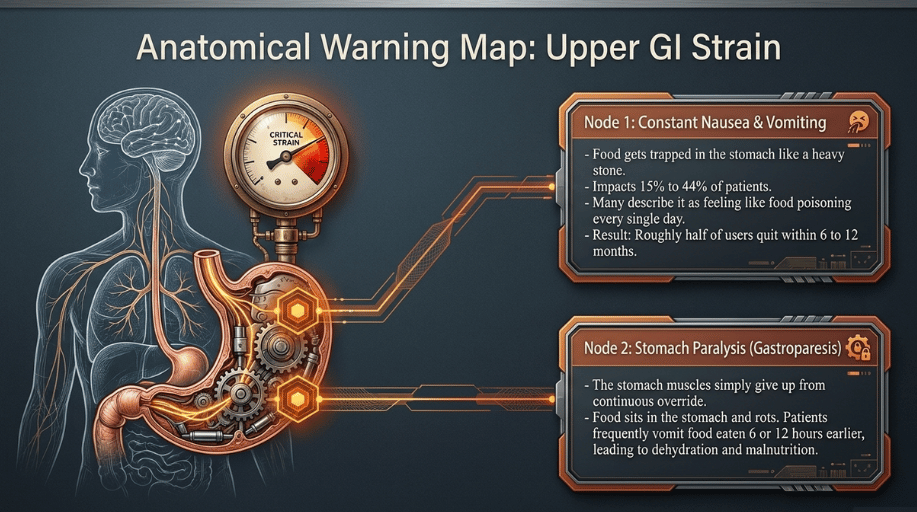
1. Constant Nausea And Vomiting
Food gets trapped in the stomach like a heavy stone. It can’t move forward easily. This causes 15% to 44% of patients constant nausea, bloating, and vomiting — described by many as feeling like food poisoning every single day. Roughly half of people who start these injections stop within 6 to 12 months.
2. Stomach Paralysis (Gastroparesis)
Sometimes the stomach muscles simply give up. This severe condition is called gastroparesis. Food sits in the stomach and rots. Patients often vomit food they ate 6 or 12 hours earlier. This leads to severe dehydration, weakness, and malnutrition.
3. Bowel Blockage (Ileus)
The slowdown doesn’t stop at the stomach. It can spread to the intestines. When intestines stop moving, waste gets trapped. This creates a life-threatening blockage called paralytic ileus, sometimes requiring urgent surgery.
4. Gallstones And Gallbladder Problems
The gallbladder squeezes out bile to help digest fats. GLP-1 injections stop it from squeezing properly, leaving bile stagnant. Rapid weight loss simultaneously dumps extra cholesterol into that stagnant bile. The result: hard, painful gallstones, often requiring emergency removal.
Part 3: The Natural, Safe Alternative — Fibre, Healthy Fats, And The “Ileal Brake”
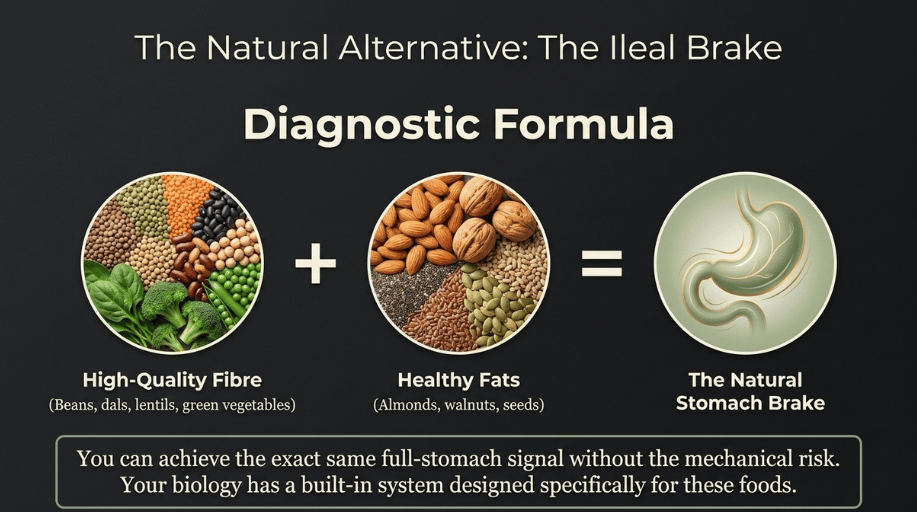
So can you get the same full-stomach feeling, without the risk? Yes — by eating the right foods.
Build meals around:
- High-quality fibre — beans, lentils, green vegetables
- Healthy fats — almonds, walnuts, various seeds and nuts
This activates a natural, built-in system called the ileal brake.
How The Natural Stomach Brake Actually Works
- Fibre adds safe volume — it absorbs water, swells up, and physically stretches the stomach safely, signaling fullness to the brain
- Slowing down naturally — healthy fats trigger a hormone called CCK, which slows the stomach just enough to properly digest them
- The deep satiety trigger — since fibre can’t be digested in the upper stomach, it travels intact into the lower small intestine, the ileum
- Natural GLP-1 release — cells there (L-cells) respond to this intact fibre, releasing your own natural GLP-1, sending a real fullness signal to the brain
The Big Difference: Natural vs. Artificial
Why is eating beans, lentils, and nuts safe, while the injection version can be dangerous?
The injection forces your stomach’s brake to stay locked “on” continuously, for days, whether your stomach is empty or full. This continuous, unrelenting force is exactly what paralyzes the stomach, and blocks the bowels over time.
Indian foods work differently. Your body releases its own natural GLP-1 only in response to actual food. Once digestion finishes, your body breaks the hormone down quickly. The stomach slows during the meal, then returns to normal movement. It never gets stuck ‘on.’ It never paralyzes anything.
Share on WhatsAppWhy This Is Where Calibrated Fasting Enters The Conversation
This is precisely the principle the Calibrated Fasting Protocol is built on. Not a permanently locked brake, forced open every hour of every day. A natural rhythm of eating and resting instead, where the digestive system gets real signals, responds to them, and returns to normal function afterward. A defined eating window filled with fibre and healthy fats does exactly what this article describes. It triggers the ileal brake naturally, meal after meal, without ever asking the gut to stay frozen for a week at a stretch.
The Discipline Behind A Brake That Actually Releases
Even ancient tradition understood this rhythm intuitively. Lord Mahavir’s own fasting was never about forcing the body into permanent shutdown. It was controlled, temporary, and followed by a deliberate return to normal eating. That discipline had a name — तप (tap), a chosen austerity, undertaken with purpose, not endured as punishment. The goal was never to break the body’s own systems. It was to test them, gently, and let them return stronger.
That’s the same logic your gut is asking for today. A brake that engages, does its job, and releases — not one welded shut by a molecule with nowhere left to go. Real संयम (samyam), self-restraint, was never about permanent restriction. It was always about a boundary you could return from.
Conclusion: Honor Your Body’s Wisdom
Your body is incredibly smart. It doesn’t need lab-made chemicals to feel full. A diet built around real fibre — dals, beans, lentils, vegetables — and healthy fats like almonds and walnuts, activates your body’s own stomach brake safely, meal after meal.
Share on WhatsAppRemember: forcing a brake to stay locked forever is like ordering every car on the highway to crawl at 1 km/h. The danger it avoids is real. But the damage it quietly causes everywhere else is just as real, and far easier to miss, until it’s too late.
Share on WhatsAppRelated Reading
- Why Do Ozempic And Mounjaro Cause Nausea? — the same “brake” mechanism, explored through GI side-effect data directly
- Are Ozempic And Mounjaro Safe? UK Reports 200+ Deaths — pancreatitis and other GLP-1 risks, backed by UK regulatory data
Frequently Asked Questions
Q: What percentage of GLP-1 users get nausea or vomiting?
A: Clinical data shows 15% to 44% of patients experience nausea, bloating, or vomiting, particularly during dose escalation.
Q: Can GLP-1 injections cause stomach paralysis?
A: Yes — gastroparesis is a documented, serious risk linked to prolonged, continuous gastric slowdown from GLP-1 receptor agonists.
Q: Can fiber and healthy fats really replace a GLP-1 injection?
A: Fiber and healthy fats naturally trigger the body’s own ileal brake and GLP-1 release, but this is a gentler, self-limiting effect — not a direct substitute for prescribed medication. Always consult a doctor before changing treatment.
Medical Disclaimer: This article is for educational purposes and does not replace medical advice. Anyone currently using or considering GLP-1 medication should consult a qualified physician before making changes to their treatment.
Take The Next Step
In case you want to check your fiber intake and gut health profile, you can do so using our free assessment tool: Gut Health Assessment.
In case you want to plan your fasting schedule for your next fast, you can do so using our free fasting planner: Fasting Protocol Design Engine.
Have questions? Message Fasting Kaka directly on WhatsApp: