
Imagine buying a brand-new smartphone. Thin, sleek, beautiful on the outside.
But there’s a catch. The battery inside is already degraded.
Unplug it, try to open a map, and it drops to 2%. Shuts down. The phone looks great. It’s practically useless for daily life.

This is exactly what’s happening to millions on weight-loss injections. Ozempic, Wegovy, Rybelsus. On the outside, they’re losing weight, looking slimmer. On the inside, their battery is quietly dying. Trapped in constant, bone-deep exhaustion.
Let’s look at the science behind this exhaustion epidemic. Why clinical trials barely mentioned it. And how to lose weight while keeping your body’s own energy generator running at full charge.
Part 1: The AI Study That Exposed The Exhaustion Epidemic
Drug companies running clinical trials use strict, pre-printed checklists. If a side effect isn’t already on the list, it often gets missed entirely. That’s partly why official drug booklets barely flagged tiredness as a major problem.
In 2026, researchers at the University of Pennsylvania looked at the real world instead. Using AI, they analysed over 400,000 Reddit posts. Nearly 70,000 real-world GLP-1 users, tracked over five years.

Published in Nature Health, the study found something clinical trials had largely missed. Fatigue ranked as the second most common complaint among real-world users. Far more prominent than official trial data suggested.
Fatigue ranked as the second most common complaint among real-world users. Far more prominent than official trial data suggested.
Share on WhatsAppPatients described feeling too tired to get out of bed, do simple office work, or even play with their children.
Real-world GLP-1 users described feeling too tired to get out of bed, do simple office work, or even play with their children.
Share on WhatsAppPart 2: Why Do Injections Turn Off Your Inner Generator?
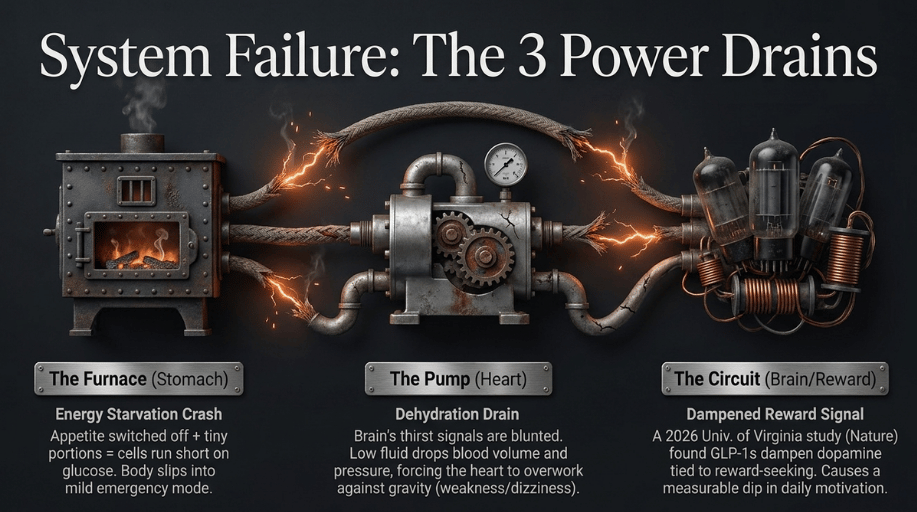
Three main reasons these drugs drain your battery so completely.
1. The energy starvation crash. These injections chemically slow your stomach and switch off appetite. Barely feeling hungry, you eat tiny, miserable portions.
Food is the coal that runs your body’s furnace. Stop feeding it suddenly, and cells run short on glucose.
Share on WhatsAppYour body slips into mild emergency mode, shutting down non-essential energy use just to survive the day.
2. The dehydration drain. These injections also blunt your brain’s thirst signals. You simply forget to drink enough water. Low fluid levels drop blood volume and blood pressure. Your heart works harder to pump blood against gravity. The result: weakness, dizziness, constant sleepiness.
3. The dampened reward signal. This part is more nuanced, but real. GLP-1 drugs don’t just act on the stomach. They reach reward circuits in the brain too. A 2026 University of Virginia study, published in Nature, found these drugs dampen dopamine activity tied to reward-seeking — the pull toward food, and in animal studies, even the drive toward voluntary exercise. Researchers stop short of claiming this flattens drive to do anything in every user. That would overstate current evidence. But for some people, a real, measurable dip in day-to-day motivation does appear to be part of the picture, on top of physical fatigue.
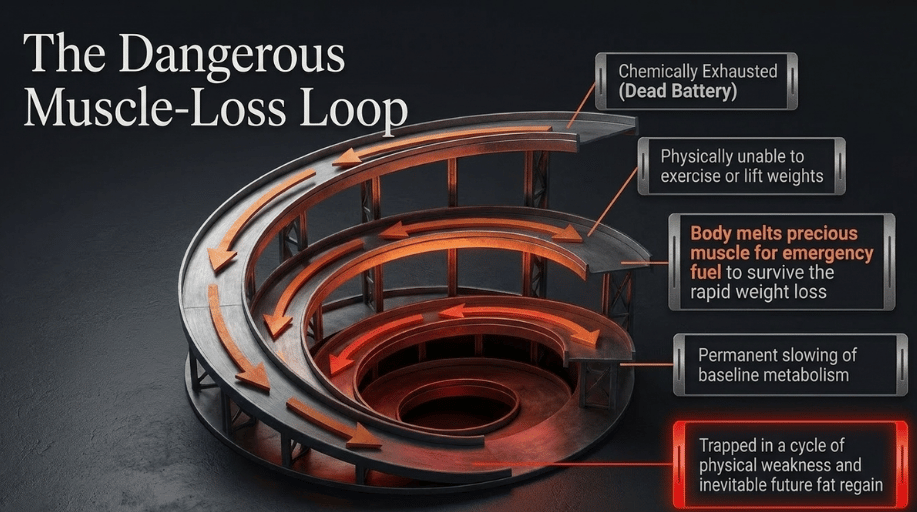
The dangerous muscle-loss loop. These injections leave people feeling like a dead battery. Many become physically unable to exercise. Lose weight rapidly without lifting weights or staying active, and your body doesn’t just burn fat. It melts precious muscle for emergency fuel. This slows metabolism permanently, trapping you in a cycle of weakness and future fat regain.
Part 3: The Natural Recharge — Proper Fasting And Satiating Whole Foods
Now picture someone skipping expensive injections entirely. Instead, they follow a Calibrated Fasting Protocol — eating within a defined window — and clean, traditional whole foods.
This person can lose fat without ever draining their battery. Many describe feeling like they’ve installed a supercharged generator inside. Here’s why.
You keep your fuel tank full. Done properly, a Calibrated Fasting Protocol doesn’t starve your body. You still eat full maintenance calories — typically 2,000 to 2,200 for an active person — inside your eating window. You’re simply giving your stomach a healthy rest, not cutting your fuel supply. Your body receives its full daily energy needs. Your baseline battery stays in the green.
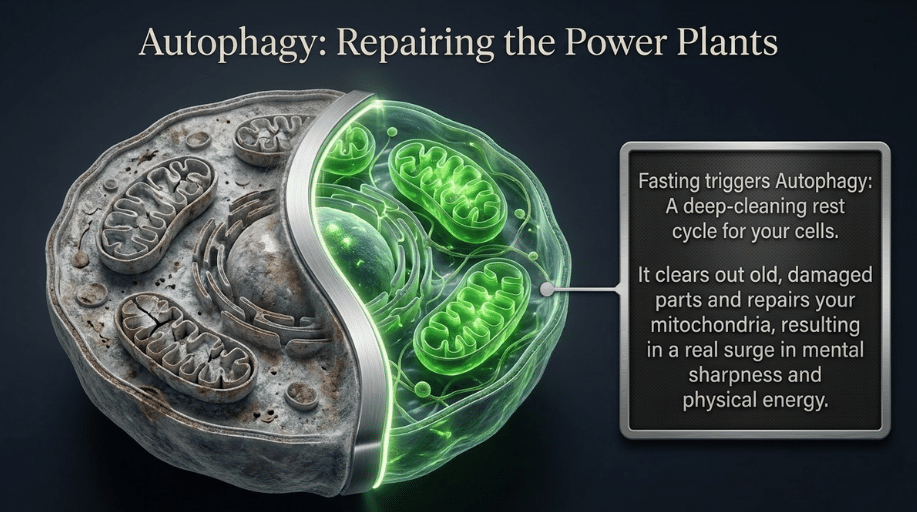
Fasting repairs your power plants. Every cell carries tiny power plants called mitochondria, responsible for your daily energy output. Fast naturally, and your body runs a deep-cleaning process called autophagy. Think of it as a rest cycle for your cells. It clears out old, damaged parts and repairs your mitochondria. This is a big part of why people practising a proper fasting protocol often report a real surge in mental sharpness and physical energy.
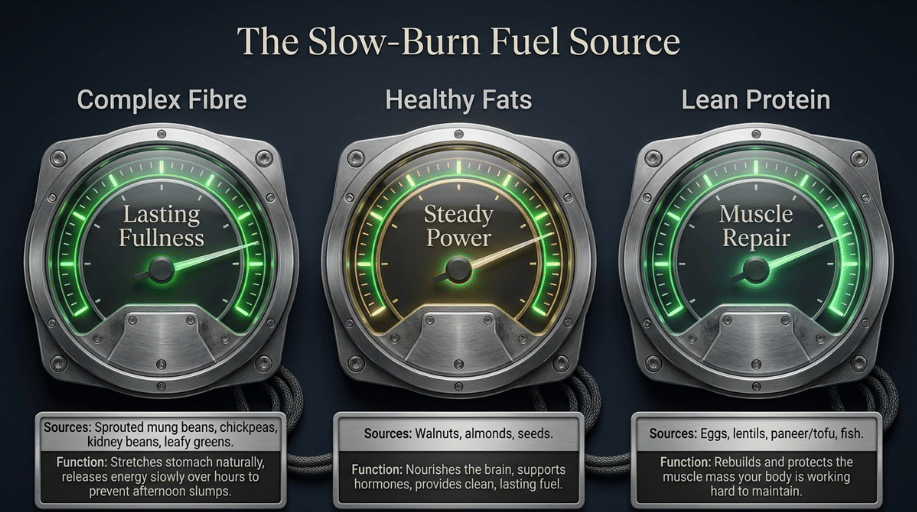
Whole foods provide steady, slow-burn fuel. Instead of crashing your system, you feed your body slow-burning fuel. Energy stays flat all day. No afternoon slump.
- 🛑 Complex fibre for lasting fullness — sprouted mung beans, chickpeas, kidney beans, leafy greens. Stretches your stomach naturally, releases energy slowly over hours
- 🛑 Healthy fats for steady power — walnuts, almonds, and seeds. Nourish your brain, support your hormones, provide clean, lasting fuel
- 🛑 Lean protein for repair — eggs, lentils, paneer or tofu, fish for those who eat it. Rebuilds the muscle your body works hard to protect
Because your energy stays high, you can go to the gym, climb stairs, or lift weights without dragging yourself through the day. That activity signals your brain to protect muscle while selectively burning fat instead.
Why This Wisdom Predates Modern Science
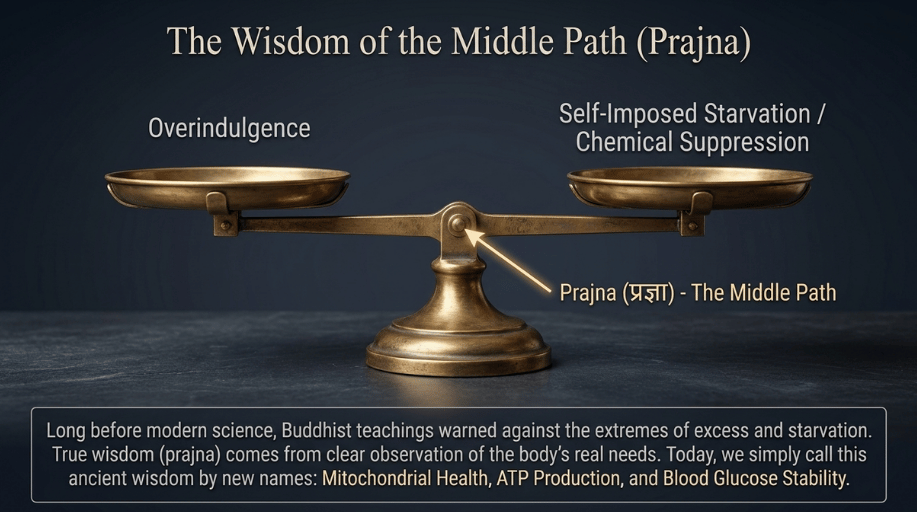
Long before modern nutrition science existed, Buddhist teaching on the Middle Path warned against two extremes. Overindulgence, and self-imposed starvation.
A properly calibrated fasting plan sits exactly in that middle ground. Never depriving the body of what it truly needs. Just changing when it gets fed.
This balance reflects something deeper too — what Buddhist teaching calls prajna (प्रज्ञा), or wisdom born from clear observation of the body’s real needs. Not from following extremes in either direction. A body denied fuel entirely cannot think clearly, let alone find any real insight. Neither can a body drowning in excess. The Middle Path wasn’t a spiritual nicety. It was practical wisdom about the body’s own energy — energy that today we simply call mitochondrial health, ATP production, and blood glucose stability.
Conclusion: Real Strength Is A Battery That Stays Charged
A lower number on the scale means little without energy to enjoy your life. Don’t trade your vitality for a chemical shortcut that leaves you weak, tired, and slowly losing muscle.
Your body already has a remarkable, natural engine built in. Practice a Calibrated Fasting Protocol. Eat full maintenance calories through clean whole foods — lentils, beans, walnuts, almonds, eggs. Stay physically active. Build the fit, energised body you actually want.
Remember: “A phone that looks perfect but dies at 2% is no phone at all. A body that loses weight but runs on empty is no victory either. Charge the right way.”
Share on WhatsAppRelated Reading
- For the full science behind autophagy and cellular energy repair, see The Municipality Truck Your Body Runs Every Day.
- For more on why GLP-1 dampens dopamine and drive, see Is Your GLP-1 Injection Running The Same Loop As A Slot Machine?.
Frequently Asked Questions
Q: Why does Ozempic cause fatigue?
A: Three main factors — reduced calorie intake causing energy shortfall, dehydration from blunted thirst signals, and dampened dopamine activity affecting motivation and drive.
Q: Was fatigue reported in official GLP-1 clinical trials?
A: It was underreported compared to real-world data — a 2026 University of Pennsylvania study analysing 400,000+ Reddit posts found fatigue as the second most common complaint among actual users.
Q: Can a Calibrated Fasting Protocol cause the same fatigue as GLP-1 drugs?
A: Not when structured properly — full maintenance calories and adequate hydration prevent the energy crash seen with chemically suppressed appetite.
Medical Disclaimer: This article is for educational purposes and does not replace medical advice. Anyone currently using or considering GLP-1 medication should consult a qualified physician before making changes to their treatment.
Take The Next Step
In case you want to check your visceral fat and metabolic profile, you can do so using our free assessment tool: Visceral Fat Calculator.
In case you want to plan your fasting schedule for your next fast, you can do so using our free fasting planner: Fasting Protocol Design Engine.
In case you have some other questions in your mind, you can message Fasting Kaka directly on WhatsApp: