
Picture a busy kitchen. A heavy-duty food mixer stands at the centre. This is your stomach.
Add ingredients, and the mixer turns. It grinds and pushes smooth batter down a pipe. Into the oven — your intestines — to be baked. A perfect, rhythmic machine.
Now imagine someone jams an iron rod into the gears. The motor hums. But the blades can’t spin.
The ingredients sit there. Getting warm. Heavy. Stale. The mixer can’t push food down. You can’t add anything new. Force more food in, and it simply overflows back out.
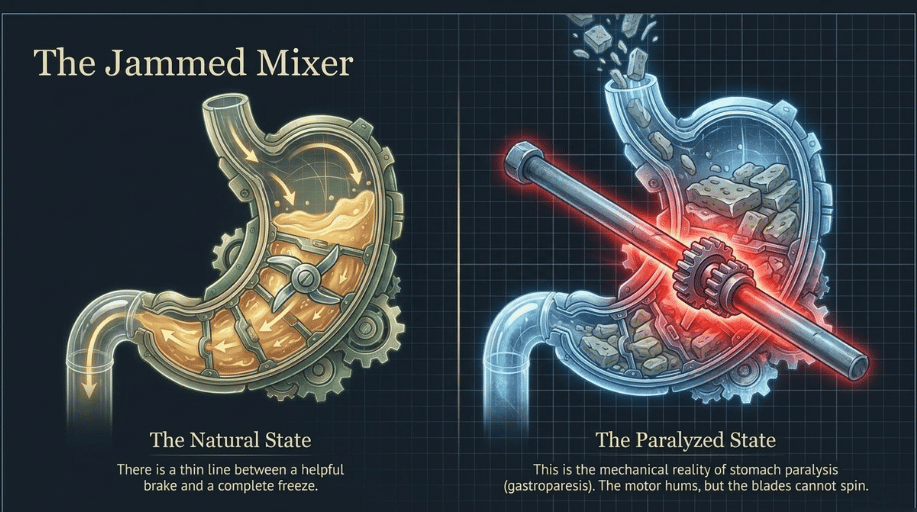
This is exactly what gastroparesis feels like from the inside. Doctors call it stomach paralysis. In the world of injections like Ozempic, Wegovy, and Mounjaro, this “jammed mixer” is the most talked-about serious risk.
In the world of injections like Ozempic, Wegovy, and Mounjaro, this “jammed mixer” — stomach paralysis — is the most talked-about serious risk. Food sits trapped, unable to move.
Share on WhatsAppPart 1: The Science Of Stomach Paralysis
To understand this, look at how the stomach normally moves. It isn’t a hollow bag. It’s a muscular organ.
To digest food, it must contract rhythmically. Crushing meals into liquid. Pushing that liquid into the small intestine.
Weight-loss injections mimic a natural hormone called GLP-1. One key job of this hormone: acting as a “stomach brake.” It slows how fast the stomach empties. You feel full sooner, and stay full longer.
But there’s a thin line between a helpful brake and a complete freeze.
Inject artificial GLP-1 weekly — semaglutide or tirzepatide — and it floods stomach receptors at constant, lab-made levels. For some patients, this chemical force completely paralyses stomach muscles. Contractions stop entirely.

Because the stomach is paralysed:
- 🛑 Food rots inside — meals stay trapped for hours, sometimes days, fermenting and decaying
- 🛑 Vomiting undigested food — patients bring up whole, recognisable food chunks eaten 6, 12, even 24 hours earlier
- 🛑 Severe sickness — trapped food triggers relentless nausea, painful bloating, acid reflux, dangerous dehydration
What The Medical Studies Reveal

This isn’t an occasional complaint. It’s a documented medical risk, confirmed by two separate large studies.
The JAMA database study compared GLP-1 users against patients on other weight-loss treatments. GLP-1 users were 3.67 times more likely to develop clinically diagnosed gastroparesis.
The TriNetX imaging study went further. It analysed non-diabetic patients undergoing a gastric emptying study — a nuclear-camera test tracking how fast food leaves the stomach. Patients on GLP-1 drugs were 2.7 times more likely to show severely delayed emptying. This confirmed true stomach paralysis on imaging, not just symptoms.
Clinical nuclear-camera studies show GLP-1 users are 2.7 to 3.67 times more likely to develop clinically diagnosed stomach paralysis (gastroparesis).
Share on WhatsAppPart 2: The Double-Edged Sword
GLP-1 drugs are built on a paradox. You live by the sword, and you die by the sword.
The drug’s biggest selling point — delaying stomach emptying to keep you full — is the exact mechanism that, pushed too far, becomes a painful disease. Chemically freeze your stomach to lose weight, and you risk permanently damaging the nerves that coordinate digestion, including the vagus nerve.
This unyielding chemical force explains something striking. Real-world data shows 50% to 75% of patients stop these injections within the first year. Constant nausea, plus the fear of stomach paralysis, becomes too much to bear.
Part 3: The Natural, Safe Alternative — Satiety Without Paralysis
Here’s the crucial question. Can you get the same “delayed emptying” effect naturally? That comfortable, lasting full feeling, without ever risking paralysis?
The answer is a scientifically proven yes.
Your body already carries a beautifully designed, self-limiting safety system. It’s called the “ileal brake.” Think of it as your body’s own natural stomach brake.
Unlike a lab-made chemical that forces the brake locked on day and night, this natural brake slows digestion only while food is present. Then it releases safely once digestion finishes.
Here’s how to activate your natural stomach brake, using simple Indian whole foods and smart daily habits.
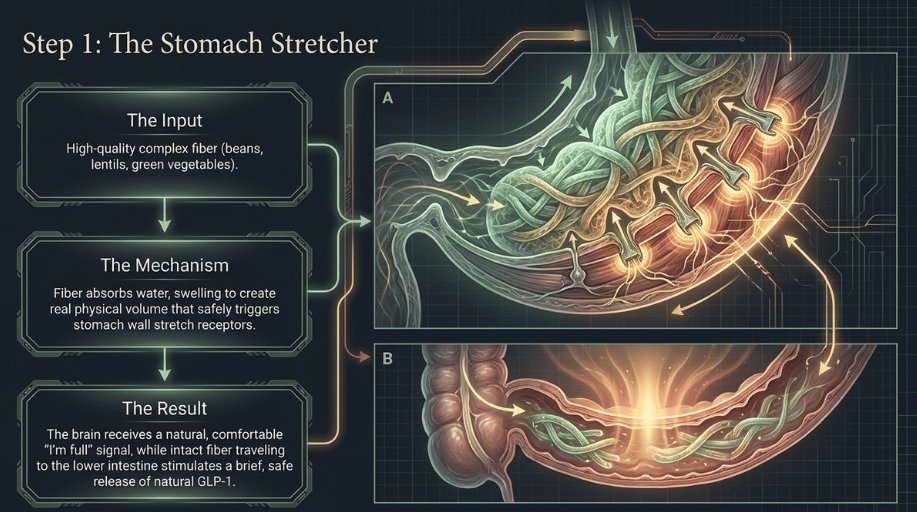
Step 1 — High-Quality Fibre (The Stomach Stretcher)
Complex fibre from beans, lentils, and green vegetables acts like a microscopic sponge. It absorbs water in your stomach, swelling to create real physical volume. This volume stretches your stomach walls safely. It triggers stretch receptors, sending your brain a natural, comfortable “I’m full” signal. Since human enzymes can’t digest fibre, it travels intact into your lower intestine. There, it triggers a natural, brief release of your own GLP-1.
Step 2 — Healthy Fats (The Natural Decelerator)
Fats from walnuts, almonds, and seeds trigger release of a gut hormone called CCK. CCK gently tells your stomach to slow contractions, giving your body time to absorb the fat properly. This slows digestion enough to keep you full for hours. But it never paralyses the organ. Your body clears natural CCK and GLP-1 within minutes of finishing a meal.
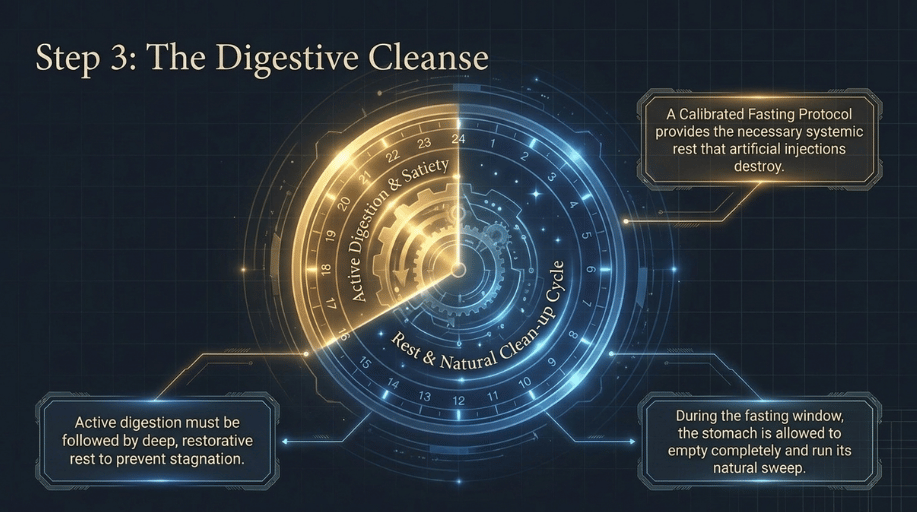
Step 3 — A Calibrated Fasting Protocol (The Digestive Cleanse)
A structured eating window — say, 9 AM to 5 PM — followed by 16 hours of rest, gives your digestive system what it actually needs. During the fasting window, your stomach empties completely. It runs a natural clean-up cycle. Unlike GLP-1 injections, which keep the stomach frozen and stagnant 24/7, this approach comes from a healthy cycle. Active digestion, followed by deep, restorative rest.
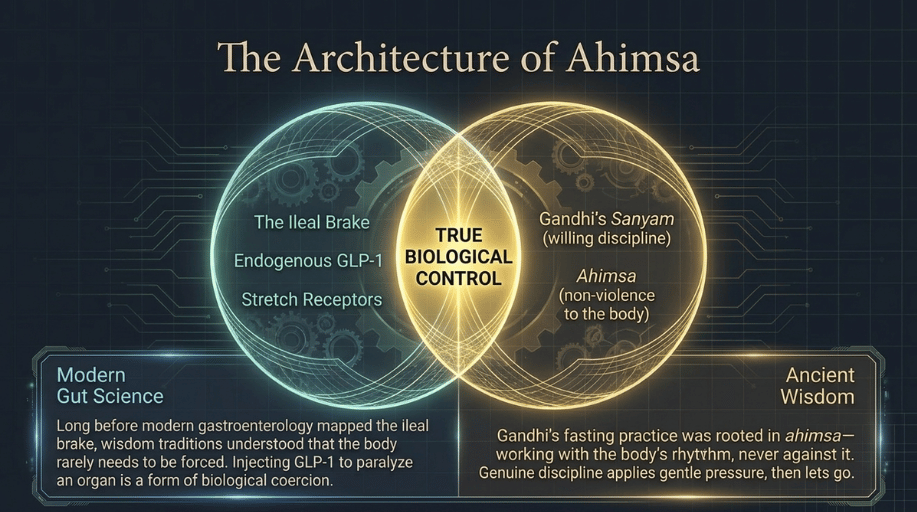
Why This Principle Is Older Than Modern Science
Long before researchers understood the ileal brake or GLP-1 receptors, wisdom traditions already grasped something essential. The body, left to its own intelligence, rarely needs to be forced into anything.
Mahatma Gandhi lived by this principle decades before gut science explained why. His own fasting practice was never about force. It was about ahimsa (अहिंसा) — non-violence — extended even toward his own body. Gandhi understood that true self-control, or sanyam (संयम), works with the body’s rhythm. Never against it.
This is precisely the difference between a chemical that locks a brake shut by force, and a natural system that applies gentle pressure, then lets go. One is coercion. The other is cooperation — the same distinction Gandhi drew between force and genuine, willing discipline.
Conclusion: Trust Your Body’s Design
You don’t need to inject expensive, lab-made chemicals. Chemicals that jam a rod into your digestive gears and risk paralysing your stomach.
Structure meals around high-quality fibre — beans, lentils, vegetables. Add healthy fats like almonds and walnuts. Combine both with a Calibrated Fasting Protocol. You activate your body’s own satiety pathways safely.
This is true health. Building a lean, fit body by working in harmony with your biology. Not by forcing it into paralysis.
Remember: “A body that digests in rhythm, not by force, is like a mixer finally allowed to run free — not one jammed shut by an iron rod.”
Share on WhatsAppRelated Reading
- For the full mechanism behind how fibre and fats trigger natural satiety, see The Stomach Brake Secret.
- For more on why appetite suppression differs from genuine digestive rest, see The Frozen Mixer companion piece on nausea and GI side effects.
Frequently Asked Questions
Q: How much more likely are GLP-1 users to develop gastroparesis?
A: A JAMA database study found GLP-1 users were 3.67 times more likely to develop clinically diagnosed gastroparesis compared to other weight-loss treatments.
Q: Can a Calibrated Fasting Protocol cause stomach paralysis too?
A: No — the natural ileal brake mechanism is self-limiting and releases once digestion finishes, unlike continuous chemical suppression from GLP-1 injections.
Q: How many people stop GLP-1 injections due to side effects?
A: Real-world data shows 50% to 75% of patients discontinue within the first year, often due to nausea and digestive discomfort.
Medical Disclaimer: This article is for educational purposes and does not replace medical advice. Anyone currently using or considering GLP-1 medication should consult a qualified physician before making changes to their treatment.
Take The Next Step
In case you want to check your visceral fat and metabolic profile, you can do so using our free assessment tool: Visceral Fat Calculator.
In case you want to plan your fasting schedule for your next fast, you can do so using our free fasting planner: Fasting Protocol Design Engine.
In case you have some other questions in your mind, you can message Fasting Kaka directly on WhatsApp: