
The "Refeed" Revolution: How Natural Fasting Triggers Your Body's Own Satiety Hormone Safely
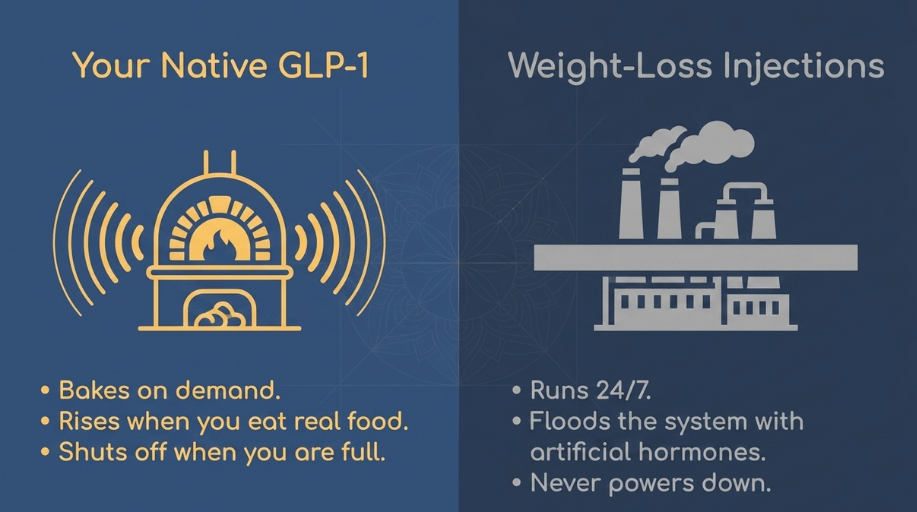
Think about a small neighbourhood bakery. It bakes fresh loaves only when customers walk in. Sells out. Shuts its ovens off for the night.
Now think about a giant industrial bread factory. It never stops. Same ovens, running 24 hours a day. Pumping out identical loaves whether anyone's hungry or not.
Your body already runs its own bakery for a hormone called GLP-1. Weight-loss injections like Ozempic and Wegovy behave like that factory. Flooding your system nonstop. Whether your body needs it or not.
Most people believe a weekly injection is the only way to get enough GLP-1 to lose weight. But your gut already makes this exact hormone. Naturally. Every time you eat real, whole food.
Let's look at how fasting switches on your body's own bakery. Why the "quick disappearance" of your natural hormone is actually a safety feature, not a flaw. And how you can lose weight without a single injection.
Part 1: The Fasting Connection — Your Natural GLP-1 Boost
Many people assume a weekly injection is the only real option. Science tells a different story.
Practice a consistent Calibrated Fasting Protocol — eating within a defined window, say 9 AM to 5 PM, fasting the remaining 16 hours — and something remarkable happens inside your gut.
- Resting the gut — during your 16-hour fast, your digestive system gets a full rest. Gut cells recover. Hormone receptors reset their sensitivity.
- The refeeding surge — break your fast with high-quality, high-fibre whole foods — kidney beans, chickpeas, lentils — and healthy fats like almonds and walnuts. The specialised L-cells lining your gut go into high gear.
- Natural release — in response to these rich, complex foods after fasting, your gut releases a real, natural surge of your own GLP-1.
The drug floods your body with an artificial hormone from the outside. Your fasting-and-refeeding protocol coaxes your body into producing its own, native version instead. The same hormone, made by your own cells, naturally suited to your body's own rhythm.
Part 2: The Two-Minute DPP-4 Shield — Why "Fast-Disappearing" GLP-1 Is A Blessing
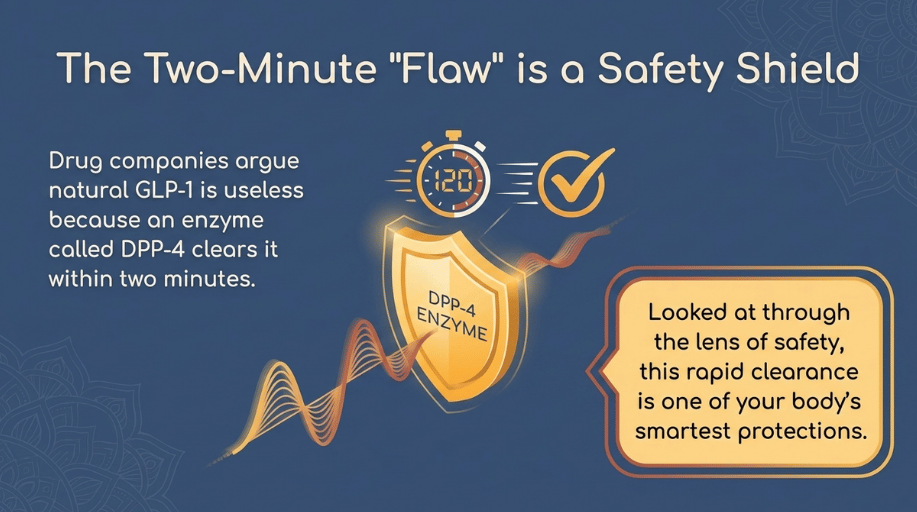
You may have heard a common argument from drug companies. Natural GLP-1 is nearly useless, because an enzyme called DPP-4 clears it within about two minutes of release.
At first, this sounds like a design flaw. Looked at through the lens of safety, it's actually one of your body's smarter protections.
The Railway Crossing Guard Analogy
Picture a busy railway crossing in a small town. Natural GLP-1 works like a careful crossing guard.
A train — your food — approaches. The guard lowers the barrier, briefly slowing traffic so the train can pass safely. Once the train crosses, the guard raises the barrier right away. Traffic flows normally again.
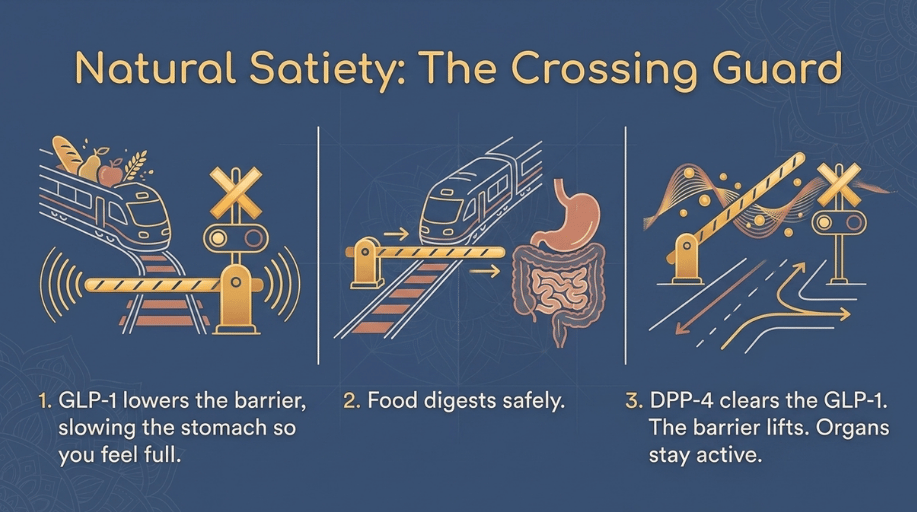
This is exactly what your body does. Your gut releases GLP-1 to slow your stomach during a meal, so you feel full. Within about two minutes, DPP-4 clears that GLP-1 away. The barrier lifts. Your stomach resumes normal contractions. Your organs stay active and healthy.
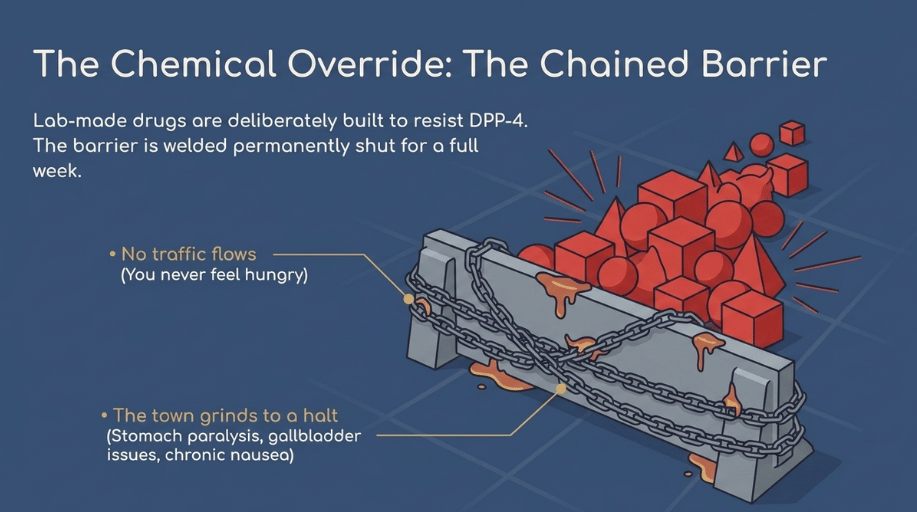
The injection behaves more like a chained barrier. The lab-made drug is deliberately built to resist DPP-4. It stays at high levels in your blood for a full week at a time. As if the crossing barrier were welded permanently shut. No traffic gets through — you never feel hungry — but the entire town grinds to a halt.
This permanently locked-down brake is a real contributor to the nausea, gallbladder issues, and stomach paralysis some patients experience.
The fact that natural GLP-1 clears within two minutes isn't a weakness. It's a safety feature. It lets you feel full during and after a meal, while protecting your stomach muscles from ever being frozen in place.
📖 For more on why GLP-1's continuous presence causes gastroparesis, see "The Frozen Mixer: The Reality Of Stomach Paralysis"Part 3: How To Optimise Your Natural Brake With Fasting And Refeeding
To get the most from your body's own GLP-1 system, follow a structured approach.
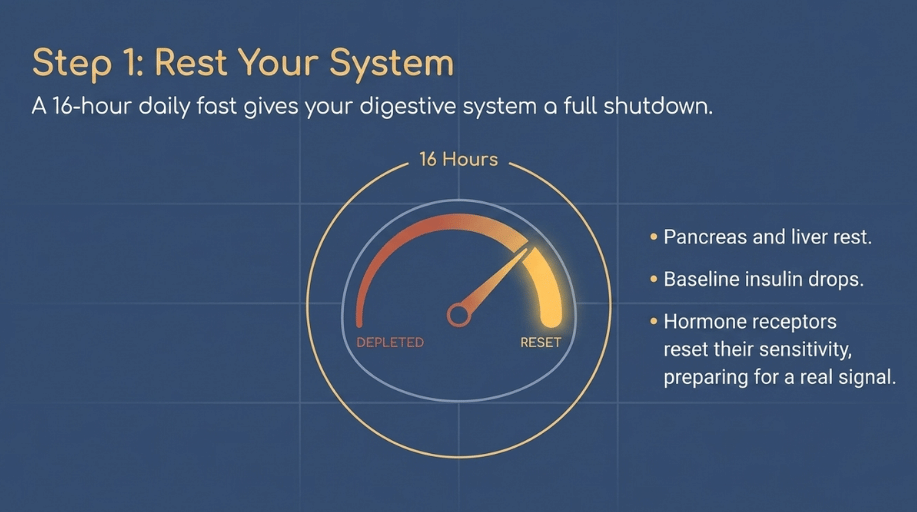
Step 1 — Rest Your System (The Fast)
Fasting for 16 hours daily lets your pancreas and liver rest. Baseline insulin drops. Your body naturally recovers some insulin sensitivity.
Because your hormone receptors aren't being flooded around the clock, they stay sensitive. They respond well when a real signal finally arrives.
Step 2 — Feed The Lower Gut (The Refeed)
When you break your fast, skip refined carbohydrates — white bread, pastries, sugary drinks. These absorb quickly in the upper stomach and never reach your lower gut. You miss out on the GLP-1 release entirely.
Instead, break your fast with whole, fibre-rich foods:
- Lentils and pulses — whole chickpeas, kidney beans, sprouted mung beans, thick lentil stews
- Nuts and seeds — a handful of walnuts, almonds, pumpkin seeds
These complex fibres can't be digested in the upper stomach. They travel intact deep into your lower small intestine, the ileum. When this untouched fibre and healthy fat reach the L-cells there, it triggers a strong, natural release of your own GLP-1 and PYY. Sending a genuine signal of deep satiety to your brain.
Step 3 — Enjoy Natural, Damage-Free Satiety
You feel deeply full and satisfied. But because your DPP-4 enzyme stays fully active, this natural brake gently releases once your food is digested.
Your stomach contracts normally. Your gallbladder empties bile as it should. Your intestines keep moving waste along. You get the appetite-control benefit of the drug, with none of the organ risk.
Why This Balance Was Never Just Biology
Long before DPP-4 or GLP-1 had names, the Bhagavad Gita described a state called samatva (समत्व) — equanimity, balance held steady through changing conditions.
This isn't a coincidence of language. Your body's natural GLP-1 system embodies exactly this principle at a cellular level. It rises when needed. It clears away just as reliably, once its purpose is served. Neither clinging, nor absent. Present exactly as long as the moment requires.
A GLP-1 injection breaks this balance by force. It refuses to clear. It insists on staying, whether the body has use for it or not. Samatva was never about suppressing a signal permanently. It was about trusting a system that knows precisely when to rise, and precisely when to let go.
The Ultimate Summary: Natural Vs. Synthetic GLP-1
| Feature | Lab-Made Injections (The Chained Brake) | Natural Fasting & Refeeding (The Smart Brake) |
|---|---|---|
| Hormone source | Artificial, injected from outside | Entirely natural, made by your own gut cells |
| Duration in body | Constant, 24/7 exposure for a full week | Pulsatile — rises after meals, clears in minutes |
| Role of DPP-4 | Blocked — the drug resists breakdown | Active — clears the hormone quickly to protect organs |
| Stomach paralysis risk | Real risk — stomach muscles can freeze | Very low — stomach moves and rests naturally |
| Weight maintenance | Often poor — regain common after stopping | Strong — supports lasting metabolic health |
Conclusion: Trust Your Body's Design
Obesity and weight gain are genuinely complex challenges. But overriding your body's delicate hormonal systems with brute-force chemicals is a real trade-off. Not a free win.
Your body was already built with real intelligence. Practice a Calibrated Fasting Protocol. Refeed with fibre-rich lentils, chickpeas, kidney beans, almonds, and walnuts. You can activate your own GLP-1 pathways naturally.
Yes, your natural hormone disappears within two minutes. That's genuinely something to be grateful for. That quick clearance is exactly what keeps your digestive organs strong, active, and disease-free.

Remember: Your body's own GLP-1 is like a bakery that bakes fresh cookies everyday, sells out, and closes its ovens on time — while the injected version behaves like a factory that never turns off the oven.
Take Charge Of Your Biological Balance
Ready to assess your current metabolic health and create a fasting schedule tailored to your body's natural satiety signals?
Medical Disclaimer: This article is for educational purposes and does not replace medical advice. Anyone currently using or considering GLP-1 medication should consult a qualified physician before making changes to their treatment.